Skip to the timeline
Deckel

The Deckel FP1 and the toolroom

A Munich shutter maker built a milling machine that changed around the work instead of moving the work between machines.

This timeline places the FP1 among the milling machines before it, follows Friedrich Deckel's firm through the Second World War, including the forced labour it used, and ends with the firm's later history. Each event cites the sources that were read, and says where they disagree.

Before WW2

01

Milling machines in American armouries

Milling machines appeared in American armouries around 1818, and Eli Whitney and Simeon North both used plain milling by 1820. Who built the first is disputed: a machine long credited to Eli Whitney may date from after his death, and Simeon North and Robert Johnson of Middletown have been proposed instead.

Sources & notes 2

Roe (1916) credits Whitney; later historians, summarised by Wikipedia, dispute both the date and the attribution. Those later works were not read.
03

The Brown & Sharpe universal milling machine

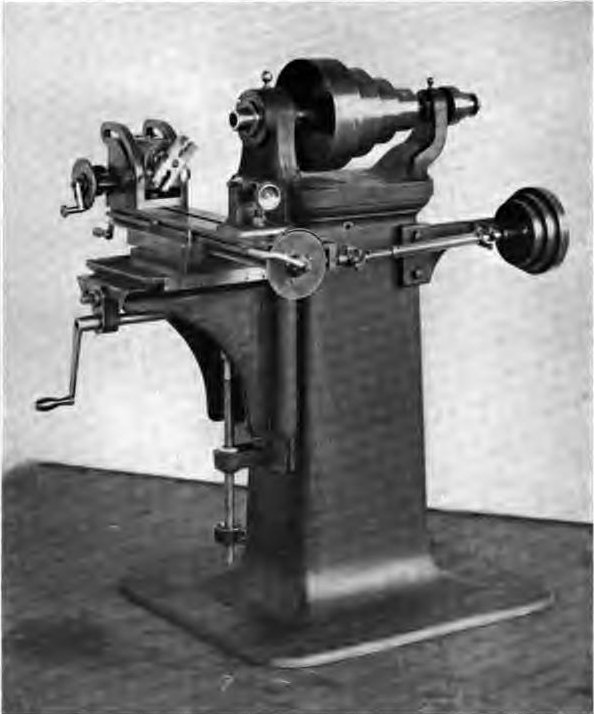
Frederick W. Howe of the Providence Tool Company asked Joseph R. Brown for a way to cut the spiral flutes of twist drills, which were then filed by hand. Brown's answer was the universal milling machine, with an index head geared to the table feed and a knee that raised the table on the column. The first was delivered to Providence Tool on 14 March 1862.

Photograph of an early Brown & Sharpe universal milling machine: a cone pulley spindle on a column, a swivelling table with an index head, and a knee raised by a screw.
"First Universal Milling Machine, 1862", as published in 1916. J. W. Roe, English and American Tool Builders (1916), plate facing p. 208. Public domain. · Read the source ↗
Sources & notes 3

Roe dates the invention to 1861–62; the delivery date is the American Precision Museum's. The Science Museum's example is dated 1865 and is probably a later machine of the type.

04

Friedrich Deckel's training and first workshop

Friedrich Deckel was born on 11 December 1871 in Jungingen in Hohenzollern, the son of a smallholder and trader. After a three-year apprenticeship as a precision mechanic he worked at Zeiss in Jena, as Ernst Abbe's preferred laboratory mechanic, then in Holland and England at Siemens Brothers in Woolwich. From 1897 he was development mechanic for photographic optics at C. A. Steinheil in Munich.

At the end of 1898 he opened a small mechanical workshop of his own in Munich, at first supplying parts, for example to a telephone factory, and taking any repair that came.

Sources & notes 2

The NDB article is by F. L. Neher, who also wrote the firm's 1953 jubilee book, so it is not independent of the firm.

06

Swiss precision toolroom machines

Henri Hauser founded his firm in Biel in 1898; it later became known for jig grinding. In 1921 the Société genevoise d'instruments de physique (SIP) of Geneva built the machine à pointer, a jig borer that located holes to about a thousandth of a millimetre.

Sources & notes 2

The Hauser date rests on the successor company's own history; no source read dates the first Hauser jig borer.

07

Bruns & Deckel and the Compound shutter

In 1903 Friedrich Deckel went into partnership with Christian Bruns, inventor of an early focusing magazine camera, to make a central shutter that Bruns had conceived and Deckel constructed: the Compound. The shutter reached the market from about 1904.

Sources & notes 4

The sources disagree on the Compound's first year: 1902, 1904, 1905 and 'shortly after the turn of the century' all appear.

08

Friedrich Deckel becomes sole owner

Bruns left the firm in 1905 and Friedrich Deckel became its sole owner. From then on the business traded as Friedrich Deckel GmbH.

Sources & notes 3
09

Zeiss, the Compur shutter and a new works

By 1910 Carl Zeiss held a 16.8 per cent share of Friedrich Deckel GmbH. In 1910 Christian Bruns applied for a patent on a shutter with a clockwork retarder; Zeiss bought the patent and placed it at Deckel's disposal, and the shutter took the name Compur, from 'Compound' and the German Uhrwerk. Bruns's United States patent for the shutter was filed on 9 November 1911 and granted on 18 February 1913. Compur production began after the firm moved into its own new factory.

Sources & notes 5

The sources disagree on the Compur's first year (1908, 1911 or 1912), and the German patent DRP 258 646 marked on early shutters was not seen.

10

Machine tools built for the firm's own use

Ordinary machine tools could not reach the precision the Compur shutter needed, so Deckel designed machines of his own. The firm was building precision machine tools from 1910, and engraving, copying, milling, boring and grinding machines from 1911. A 1917 trade journal already names 'Firma Deckel, München' alongside Carl Zeiss in a photographic-trade matter. After the First World War these machines were the first Deckel products offered for sale at the Leipzig Fair.

Sources & notes 5

The 1917 journal mention was read only in snippet view, and the earliest machines are known from company and archive descriptions rather than from a surviving example.

11

The eight-hour day and 500 employees

In 1912 Deckel became the first employer in Munich to introduce the eight-hour working day. By 1914 the firm employed 500 people.

Sources & notes 2

A works pension fund (1919) and the honorary title Kommerzienrat (1916) appear in the German Wikipedia biography and were not checked further.

12

The 'FP' milling machine

In the 1920s Deckel advertised its milling machine for the trade simply as the 'FP'. It had a slender column with a T-slotted vertical table, and a flat-belt horizontal spindle that a screw moved fore and aft, and it was aimed at punch-die work.

A 1926 journal for engravers records a visit to 'Firma Deckel' to see its newest engraving machines.

Two surviving machines, no. 4453 and a grey machine numbered 3008 (3006 in an earlier owner's account), and a machine of 1919 in the Deutsches Museum in Munich are the evidence for the exhibit's model of the FP.

Loading the 3D model…

Drag sideways to rotate. Scroll to keep reading.

Deckel FP (Type F0). The exhibit's model of the FP in its punch-milling set-up, belted to the countershaft and the line shaft above it.
See how it works →
Sources & notes 5

'F0' is a modern collectors' label, the design is traced back to 1917 only by an enthusiast history, and the 1926 journal was read in snippet view. The grey survivor is no. 3008 on lathes.co.uk and to its 2021 buyer, and no. 3006 in its 2018 owner's forum post.

13

Fuel-injection pumps, a third product line

From 1924 the firm's main products included fuel-injection pumps for diesel and petrol engines. Pumps joined shutters and machine tools as the firm's third product line.

Sources & notes 2

The archive finding aid dates the pumps from 1924, while the German Wikipedia biography says 1927.

14

Honours, a jubilee and the engraving machines

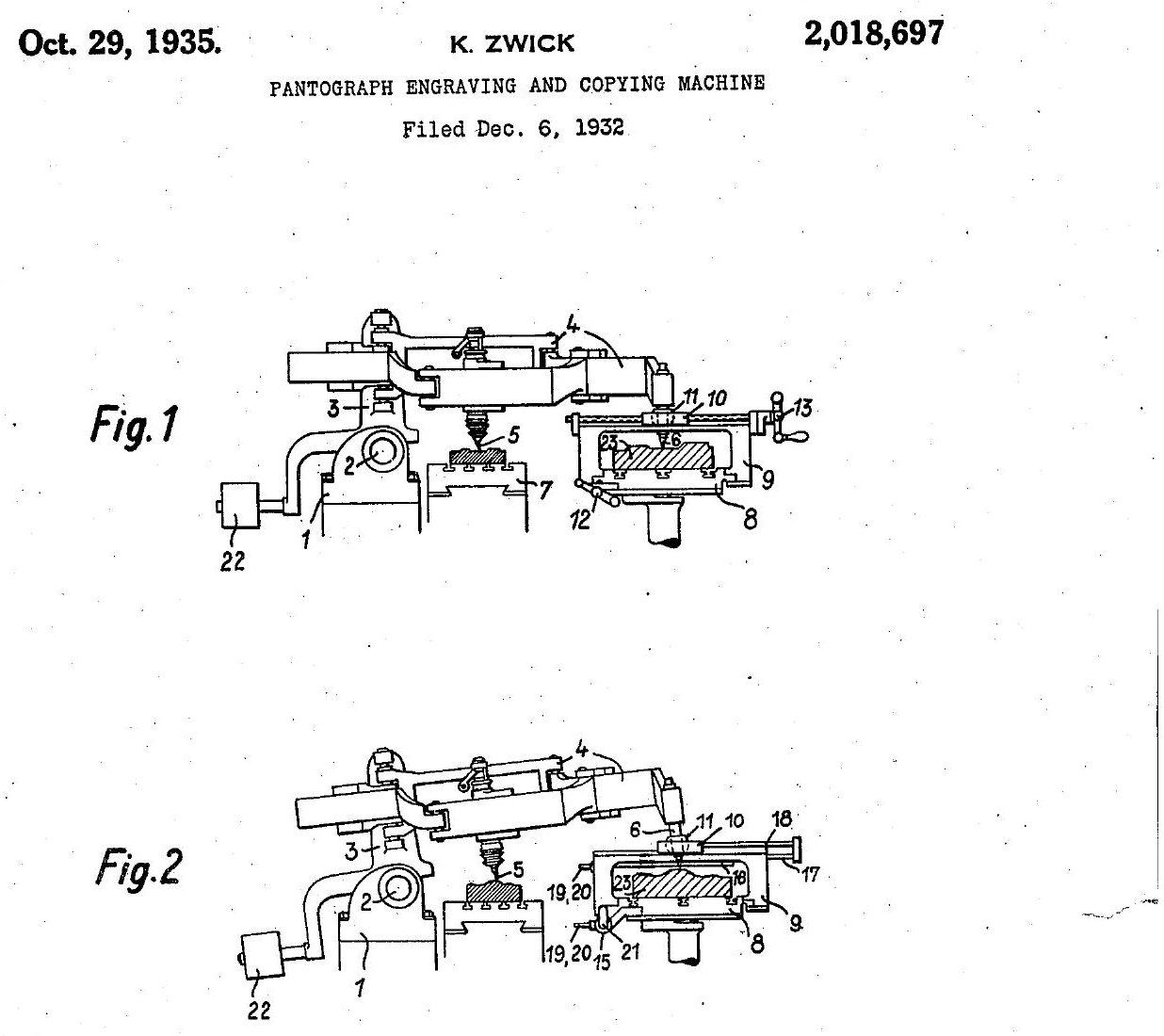
In 1928 the Munich technical university made Friedrich Deckel an honorary doctor of engineering, and the firm marked its twenty-fifth year with a commemorative pamphlet. From 1932 the Munich inventor Kurt Zwick assigned patents for a pantograph engraving and copying machine and for an engraving machine for curved work to Friedrich Deckel, followed by a cutter grinder in 1936.

Patent drawing in two side views of a pantograph engraving machine: a pantograph arm on a column carries the cutter spindle over the work, and a stylus on the right traces a pattern clamped on a separate table.
Kurt Zwick's pantograph engraving and copying machine, filed in 1932 and granted in 1935 with Friedrich Deckel as assignee. The stylus follows a pattern and the pantograph repeats its path with the cutter. K. Zwick, US patent 2,018,697 (1935), sheet 1. Public domain. · Read the source ↗
Sources & notes 5

The 1939 cutter-grinder patent names the assignee "Friedrich Deckel Präzisionsmechanik und Maschinenbau", showing that the machine-tool side traded under its own name before the war; when that name was first used is not known.

15

The FP1 universal milling machine

The Deckel FP1 universal milling machine appeared in the early 1930s. An early operating manual describes a box column standing on a coolant-tank base, with the spindle head moving along the horizontal spindle axis at the top and a knee-slide carrying the vertical table up and down the column. The first hundred machines had change-wheel feeds and small levers instead of the later "stickshift".

Loading the 3D model…

Drag sideways to rotate. Scroll to keep reading.

Deckel FP1. The exhibit's model of the FP1 Mk 1.
See how it works →
Sources & notes 2

The start date is uncertain: a trade journal gives 1931 and an enthusiast history gives 1932 to 1934, and no primary launch document has been found.

16

Lindner's optical jig borer

Herbert Lindner showed his first Lehrenbohrwerk — a jig borer that combined the machine with an optical measuring system — at the 1933 Leipzig Fair. By 1968, 1,200 had been built. His patents cover jig borers of 1933 and 1934 and coordinate boring machines of 1936 and 1937.

Sources & notes 1
17

The Mk 1 and the 'stickshift'

An advertisement of 1935 announces the first "stickshift" model of the FP1, with lever-selected spindle speeds, change-wheel feeds and a ball-handled lever for the feed directions. This Mk 1 form continued from the mid-1930s to the late 1940s.

Sources & notes 1

This rests on an enthusiast history and a dated advertisement; the exhibit's own dating of its machine, about 1936 to 1945, comes from the project brief rather than a document.

18

The Bridgeport turret mill

Rudolph Bannow conceived the Bridgeport turret milling machine in 1936, and the first machine was shipped in 1938. Serial no. 1 survives at the American Precision Museum, and more than a quarter of a million have been built.

Sources & notes 1

This account rests on the American Precision Museum's statement about serial no. 1.

The war

19

Machine tools and the FP1 in the war years

About 4,100 FP1s had been built by the end of the war in 1945, and in the late 1930s the firm also offered other special machine tools for general sale as German rearmament grew. A study of forced labour in Munich's war economy labels Deckel as armament production, and a Swiss commission's research describes the firm's machine-tool business abroad through a Zurich company. No source read describes where FP1s were used in the war, and none names a part made on one.

Sources & notes 3

The 4,100 figure comes from an enthusiast history and is unsourced, and the Swiss study was read only in snippet view.

20

War goods and pumps for BMW aero engines

By the start of the war the workforce had risen to 2,200. From 1 September 1939 shutter production was cut back and the firm changed over to goods important for the war, including fuel pumps for BMW aircraft engines; a 1942 article on the BMW 801 aero engine names Friedrich Deckel of Munich as the maker of its direct-injection pump.

Sources & notes 4

The BMW 801 pump is attested by two independent sources, but the original 1942 article was not read; no source read names any other wartime product for Deckel.

21

Forced labour: the Zielstattstraße camp

From July 1942 Deckel ran a camp in the Zielstattstraße for about 1,400 forced labourers from the occupied Soviet Union, most of whom worked at Deckel. The armaments inspectorate had appointed the firm as camp administrator by decree, against its resistance, and it formally acted only as the arm of the German Labour Front. A prisoner-of-war camp in the Waakirchner Straße was also run by the firm.

Sources & notes 2

Heusler's study was read in Google Books snippet view, and the pages following p. 204 were not visible.

22

Bomb damage to the Deckel works

The air raids on Munich scored direct hits on Deckel's administration building and on its pump and machine-building plants. The works were badly damaged, so that new buildings were needed after the war.

Sources & notes 2

The sources disagree on the date: the post-war factory's architects say the 1943 raids, while the city-archive account places the raid it describes between pages referring to July 1944.

23

Escape from the labour camp during an air raid

During the air raid of the night of 6–7 September 1943, about 300 people escaped from the Zielstattstraße camp alone. Police and Waffen-SS cordoned off the city and the stations.

Sources & notes 1

This episode was read in Google Books snippet view.

After the war

24

Restart under provisional management

Immediately after the war, reconstruction began on the occupying power's orders under provisional management. Shutter production restarted with pre-war models, and the new Zeiss-Opton in Oberkochen took over the old business relations.

By the 1948 currency reform production was running at full speed, now mainly shutters. The bizonal dismantling list of October 1947 named thirteen Munich works, but Deckel was not on it.

Sources & notes 3

The claim that Deckel was not dismantled rests on its absence from the October 1947 list; earlier lists were not seen.

26

Fifty years; three thousand employees

In 1953 Friedrich Deckel GmbH employed 3,000 people and marked its fiftieth year with a jubilee book. Machine-tool output had begun to grow significantly from the late 1940s, but the jubilee brochure was still almost entirely about the camera products.

Sources & notes 3

The 1953 jubilee book itself was not read, and the description of the brochure comes from a collector's history.

27

Carl Zeiss takes the Compur shutter works

Carl Zeiss bought the Compur shutter works, and the shutter company was renamed Compur-Werk GmbH & Co. in 1961. From the late 1950s the firm concentrated on machine tools, building a new works on the bomb-damaged site from 1956/57, with a seven-storey administration building following in 1962. The FP1 changed with it: the all-lever Mk 2 appeared in the mid-1950s and the dial-controlled Mk 3 in the early 1960s.

Sources & notes 6

The sources disagree on when Carl Zeiss bought the works (1958 or the mid-1950s), and a collector's claim of a new company in the early 1950s is unconfirmed.

28

About fifty thousand FP1s

By the mid-1960s about 50,000 FP1s had been built. No primary production count is known.

Sources & notes 2

The total comes from a trade-press history and a collector's history, which agree, but neither cites a primary count.

29

Friedrich Deckel becomes a public company

In 1972 the Friedrich Deckel Präzisionsmechanik und Maschinenbau KG, by then the fourth-largest machine-tool maker in West Germany, became the Friedrich Deckel Aktiengesellschaft. Shutter making ended in Munich in 1976 and moved to Prontor in Calmbach.

Sources & notes 3

The account rests on an archival description of the firm's surviving records, not on the records themselves.

30

Deckel Maho, Gildemeister, DMG MORI

In 1993 Deckel merged with Maho AG of Pfronten and Kempten to form Deckel Maho AG. The merged firm filed for bankruptcy in 1994 and was taken over by Gildemeister, whose machine-tool business later became DMG. Cooperation with Mori Seiki began in 2009, and the joint brand DMG MORI dates from 2013.

Sources & notes 3

The trade-press chronology used here was written for DMG MORI and is not independent; the archival descriptions agree with it.